📢 Join Our WhatsApp Channel
Get exam alerts, answer keys & study updates instantly.
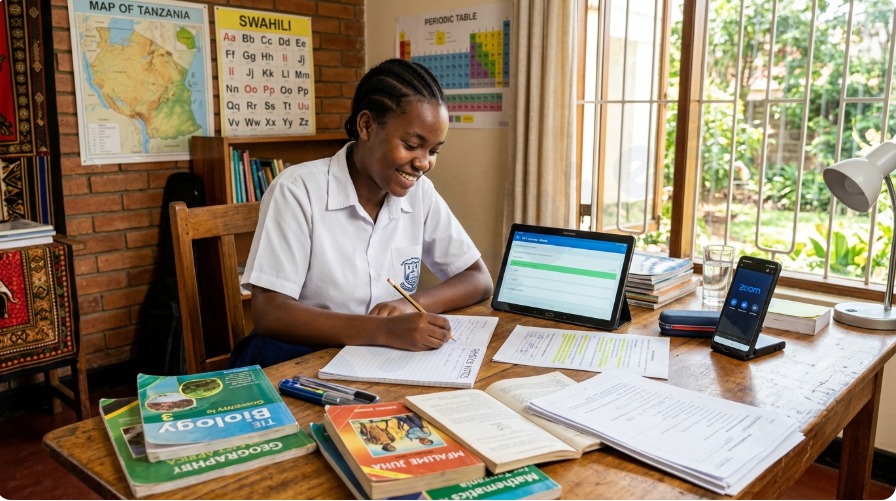
Use Multiple Resources
Why One Resource Is Never Enough
Relying on a single textbook or resource limits your understanding. Every author has biases, different teaching styles, and varying levels of depth. When you use multiple resources, you encounter concepts from different angles, see various examples, and develop a more comprehensive understanding.
Think of it like building a house—you need many different tools to complete the job. Similarly, learning requires multiple resources to build a complete picture. A concept that seems confusing in one textbook may become perfectly clear when explained differently in another. This is why students who use diverse resources consistently outperform those who stick to a single source.
For Tanzanian secondary school students, using multiple resources is especially important because:
- Different textbooks cover topics with varying depth
- Online resources can provide visual explanations
- Past papers show exam patterns
- Notes from different teachers offer diverse perspectives
How to Choose Your Resources
Your primary textbook: Choose a standard textbook recommended by your school. This should be your foundation. It will provide the core structure of your learning. Tanzania has well-known textbooks for each subject that cover the NECTA syllabus comprehensively. Start with these.
Online videos: Videos provide visual and auditory explanations. YouTube has many educational channels that explain concepts in an engaging way. The combination of seeing and hearing is more effective than reading alone.
Past papers: Past papers are practical application that reveals what you truly know. They test your understanding and help you practice exam-style questions.
Study notes: Condensed summaries help you review and consolidate information. Notes are especially useful for revision before exams.
Educational apps: Apps provide interactive learning tools. They often use gamification to make learning more engaging and effective.
Teacher notes and handouts: Teachers often provide insights and emphasis on what's most important for your exams. These are valuable resources because they come from experienced educators who understand the exam system.
Tanzanian-Specific Resources
Here are some resources you should consider using:
Standard textbooks: Each subject has recommended textbooks that cover the NECTA syllabus. Your school likely uses these.
NECTA past papers: Available online and from your school, these are essential for exam preparation.
Online resources:
- YouTube educational channels (subject-specific explanations)
- Educational WhatsApp groups (where students share resources and ask questions)
- Tanzanian educational websites (offering notes and past papers)
Library resources: Many schools and local libraries have additional textbooks and reference materials. Don't just rely on your personal books.
Teacher notes: Teachers often provide supplementary notes that highlight key topics and common exam questions.
How to Use Multiple Resources Effectively
Start with your primary textbook: Build your foundation with a single, reliable source. Read it thoroughly and take notes. Understand the core concepts.
Use videos for challenging topics: When you encounter something you don't understand from the textbook, watch a video explanation. Visual explanations often make difficult concepts click.
Cross-reference information: Check how different sources explain the same concept. If you find something confusing in one textbook, see how another textbook explains it.
Create your own synthesis: Combine information from multiple sources into your own notes. This is where the real learning happens. You're processing and organizing information, which leads to deeper understanding.
Practice with different question types: Each resource offers unique practice opportunities. Use textbooks for conceptual questions, past papers for exam-style questions, and online resources for interactive practice.
Organize your resources: Keep your resources organized so you can find them easily when you need them. This includes:
- A folder or binder for notes
- A filing system for past papers
- Bookmarks for online resources
- A list of useful resources you've found
Pros and Cons of Different Resource Types
Textbooks:
✅ Structured and comprehensive
✅ Reliable and accurate
✅ Follows the syllabus
❌ Can be outdated
❌ Single perspective
❌ Dense reading
Online Videos:
✅ Visual and auditory
✅ Engaging and easy to understand
✅ Free and accessible
❌ Varying quality
❌ Potential distractions
❌ Can be unverified
Past Papers:
✅ Exam-specific practice
✅ Reveals weak areas
✅ Builds exam confidence
❌ Limited topics
❌ Need marking scheme
❌ Can be repetitive
Notes:
✅ Condensed and organized
✅ Easy to review
✅ Can be personalized
❌ May miss details
❌ Quality varies
❌ Someone else's organization
Educational Apps:
✅ Interactive and engaging
✅ Gamified learning
✅ Immediate feedback
❌ Requires device
❌ Can be distracting
❌ Content may be limited
Tips for Using Multiple Resources Without Overwhelming Yourself
Set a plan: Decide which resources to use for each study session. Don't try to use all resources at once.
Focus on quality, not quantity: A few good resources used well are better than many poor resources.
Use resources sequentially: Start with textbooks, then videos, then practice with past papers.
Combine resources actively: Don't just passively consume resources. Take notes, answer questions, and apply what you learn.
Review regularly: Regularly review what you've learned from different resources to consolidate knowledge.
Adapt your resource use: If a resource isn't helping you, switch to a different one.
Common Mistakes to Avoid
Resource overload: Trying to use too many resources at once and not mastering any.
Sticking to one source: Using only one textbook or one set of notes and missing out on other perspectives.
Ignoring online resources: Not taking advantage of the wealth of free resources available online.
Not practicing: Reading about concepts without actually practicing problems or answering questions.
Copying, not understanding: Copying notes from others without understanding them yourself.
💡 Pro Tip: Different perspectives help you develop a more complete understanding. When you encounter a difficult concept, seek out at least three different explanations—from a textbook, a video, and a peer or teacher. This approach will reveal the concept from multiple angles, making it much easier to understand and remember. In the Tanzanian context, this means using your primary textbook, a YouTube video, and your teacher's explanation to fully understand a topic.
Remember: The best resource is the one that helps you understand. If you're struggling with a concept, don't just read the same textbook over and over—try a different resource. The investment in finding the right resource will pay off in your understanding and exam performance.